Lamotrigine and Ventricular Arrhythmia among Children and Youth: A Target Trial Emulation Using National Claims Data from the United States
Abstract
Lamotrigine (LTG), widely used for epilepsy and mental health disorders, acquired a cardiac safety warning from the US FDA in 2020 due to theoretical concerns for inducing ventricular arrhythmia (VA) in patients with cardiac disease, based primarily on in vitro studies. Recent epidemiologic evidence in adults suggests no increased risk of VA with LTG, but whether these findings extend to children and youth is unclear.
We emulated a hypothetical pragmatic trial using US national claims data (Jan 2001-Feb 2020). We included children and youth (2-24y) newly initiating LTG or oxcarbazepine (OXC) and followed them from drug initiation to the earliest of VA outcome (adapted from validated algorithm in children, PPV 95%), disenrollment, treatment discontinuation, comparator drug initiation, or Feb 29, 2020. We applied propensity score-based inverse probability of treatment weighting to adjust for 80 baseline covariates and used weighted Cox regression to estimate the adjusted HR with 95% CI.
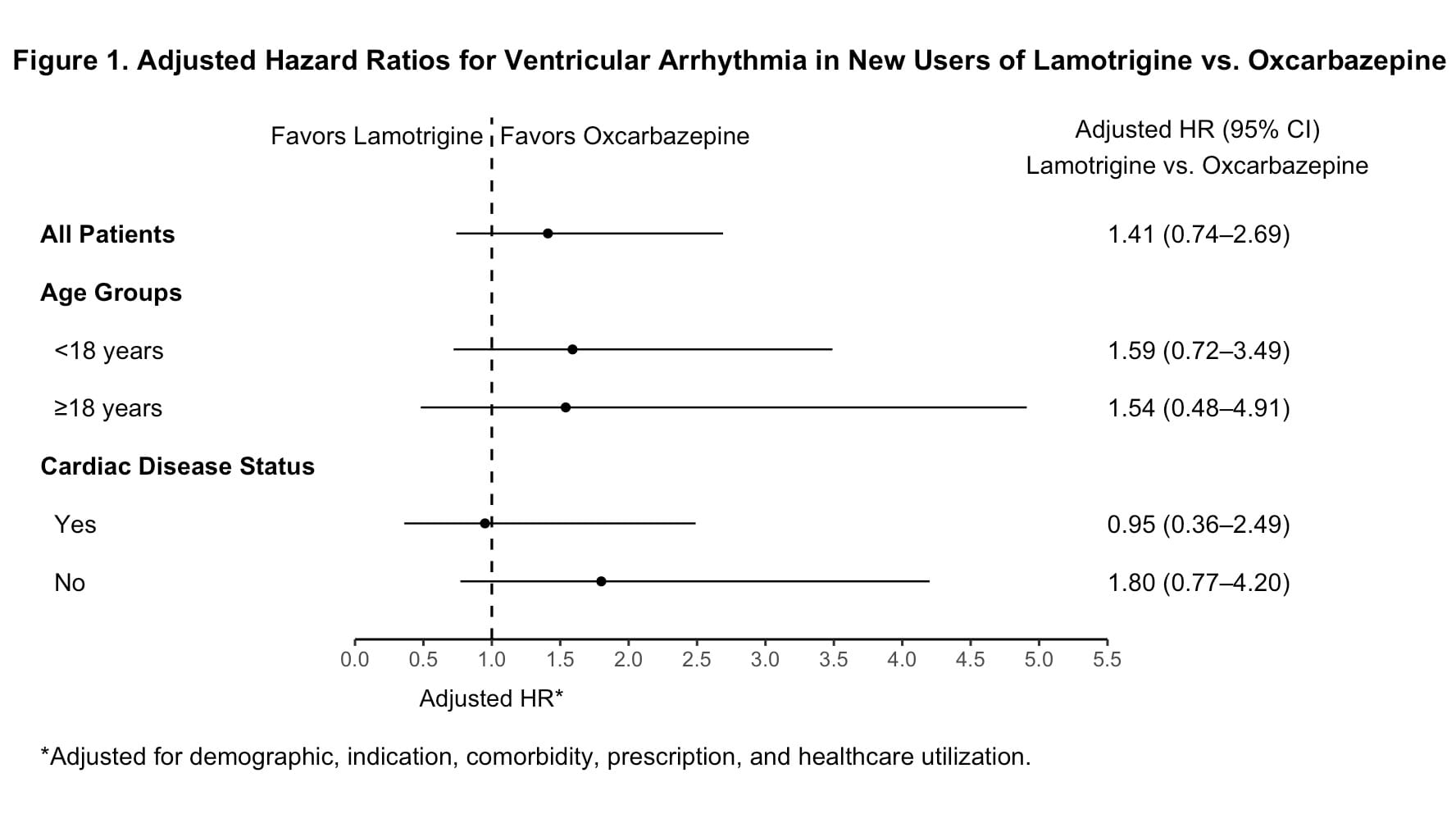
We identified 515,065 LTG vs. 440,511 OXC new users. For LTG, depression was the most common indication (prior 30-day diagnosis) (26.7%), followed by bipolar disorder (22.9%), anxiety (16.6%), attention-deficit/hyperactivity disorder (ADHD) (15.5%), and epilepsy (10.0%). For OXC, it was ADHD (25.5%), followed by depression (17.1%), conduct disorder (16.4%), bipolar disorder (15.7%), and epilepsy (14.3%). During follow-up, 34 and 18 patients in the LTG vs. OXC group had VA (weighted incidence rate per 100,000 PY: 11.4 vs. 7.9; RD: 3.5; 95% CI, -2.7, 9.7). LTG showed a numerically higher rate of VA compared to OXC (HR: 1.41; 95% CI, 0.74, 2.69). Among those with cardiac disease, the estimated association was close to the null (HR: 0.95; 0.36, 2.49).
We did not see a clear increased risk of VA with LTG compared to OXC in children and youth, especially in those with pre-existing cardiac disease. Regardless, the absolute risk difference appears to be small overall for this rare outcome.